Treatment and trials
Why ABS-0871 matters to people with CMT2C
On 20 October 2026, FDA decision-makers will hear directly from people living with CMT2C.
- CMT2C is rare and progressive, and it can reach the voice and breathing. No treatment can yet change its course [6].
- ABS-0871, now in early development, is the first drug designed to block the cause of CMT2C, an overactive TRPV4 channel [4].
- For us, even slowing the disease down would be a meaningful result.
Where ABS-0871 is on its journey
ABS-0871 has passed its first safety study, and a trial in people with CMT2C is in the works. FDA approval would come after that.
20October 2026FDA Patient Listening Sessionfor the CMT2C/TRPV4 community, organized by the CMTAA private meeting: the speakers have already been chosenI will share notes from the session here as soon as they are available.
Why it matters to us

Klaudia Warner
I was born with very weak thigh muscles, joint contractures and clubfoot, and have had orthopedic surgeries since early childhood. I am the mother of a three-year-old, and I write this site.
I know ABS-0871 is an experimental medicine, and that experimental medicines carry risk. I have weighed that risk, and I would take it.
Even a small effect would matter to me. If all ABS-0871 did was slow things down a little, it would be worth it: more time to keep up with my daughter, a little longer before my hands lose the small, careful movements I rely on every day, even one more day of walking on my own. With CMT2C, small changes are never small. Every bit of strength I lose turns something ordinary into a problem to solve. A little more control in my hands or on my feet means fewer problems to solve and more life to live. It is the difference between living my day and engineering my way through it.
When a disease slowly takes your strength and can reach your voice and your breathing, the risk of trying something new looks very different from the risk of waiting. The people in our community I talk to feel the same way. We are not asking for a promise. We are asking for the chance to find out.
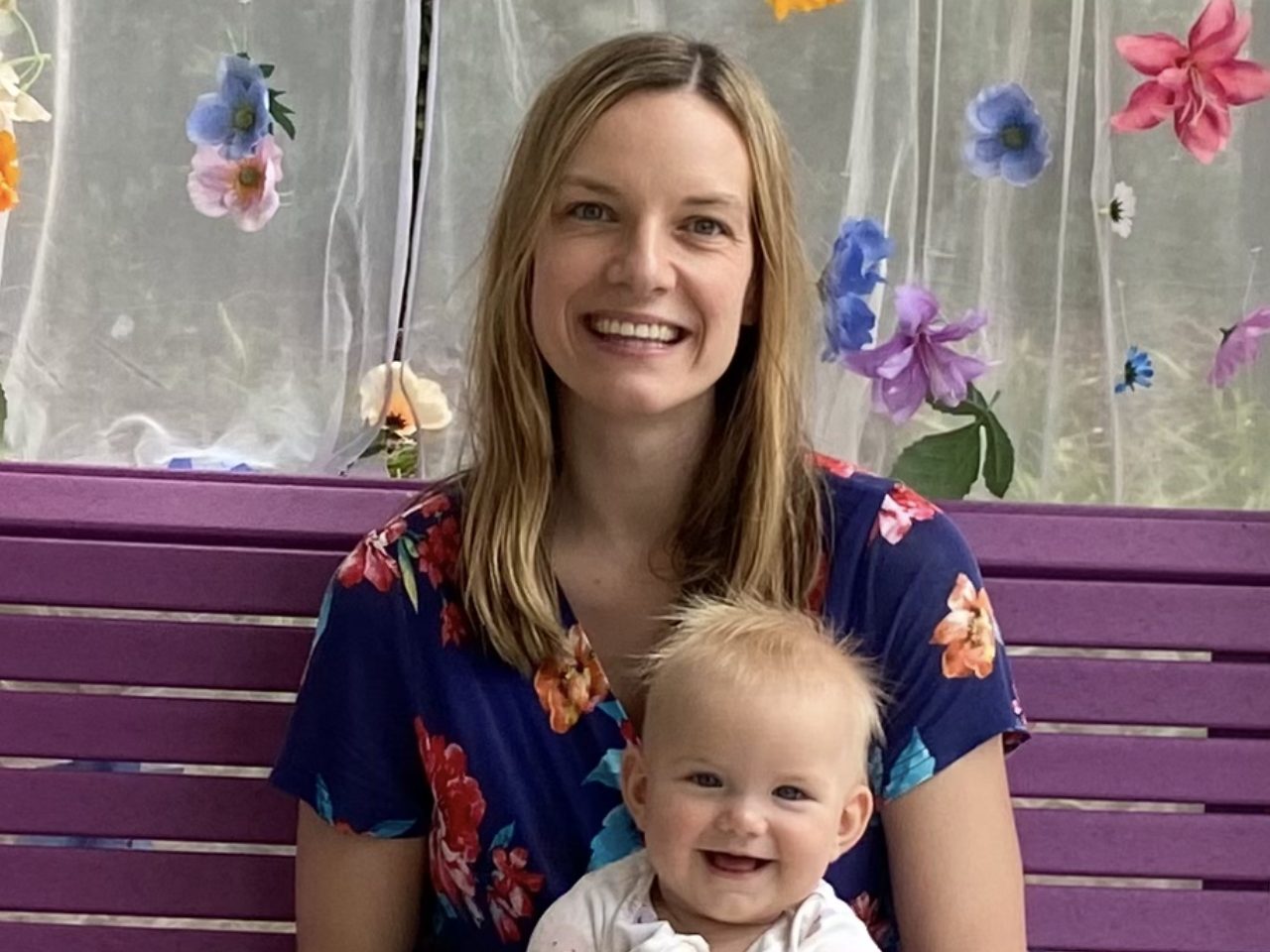
Patrycia Leja
I am a psychiatric pharmacist and a director of pharmacy, I teach yoga, and I am Lena’s mother. Many of my relatives have more severe symptoms, including my sister, who is also my best friend.
ABS-0871 matters to me because slowing this disease could make a real difference for me and my family.
I know it is experimental. We do not know yet whether it helps, and its risks need careful study. As a pharmacist and as someone with CMT2C, I want the chance to weigh that for myself and decide whether to take part in research.
Even a small benefit would matter. If I kept more of my strength, I could carry Lena comfortably for longer, feel steadier on walks, and still have energy for my family after work. It could help me keep working as a pharmacist, teaching yoga, and doing the everyday things that make my life feel like mine. For my relatives, it could mean breathing and speaking more easily, needing less help to look after their children, and taking part in family life with less pain.
When a disease keeps progressing, waiting has consequences too, and I have to weigh that in every decision. I want researchers to understand what a meaningful benefit looks like to patients. Staying stable, or even getting worse more slowly, would mean a great deal to us.
The more we know and the more options we have, the better our choices can be. Please support our community. I hope research on ABS-0871 can answer the questions we urgently need answered. This matters for me, for my sister and the rest of my family, and for the generations after us. I want people with CMT2C to have real choices and more years to live the way they want.
Why would ABS-0871 matter to you?
If you live with CMT2C, your reasons belong here too. Tell me in your own words what slowing this disease would mean for you, and with your OK I will add your words to this page. Share your story
The listening session
The Charcot-Marie-Tooth Association (CMTA) organized this listening session with the FDA on behalf of the CMT2C/TRPV4 community. In a private, 90-minute virtual meeting, FDA decision-makers will hear from individuals and families living with this type of CMT, from a young child to adults who have lived with it for years [104]. The speakers have already been chosen, so the session is not open to anyone else.
Listening sessions are not tied to a single drug trial or application [104]. Stephanie Carmody, who started the TRPV4 patient group on Facebook, explains that, under the FDA’s rules for these sessions, speakers talk about what a treatment would mean to them in general and do not discuss any specific treatment. That means ABS-0871 and the company developing it will not come up by name, so this page is where I can say why the drug matters so much to us.
- what the disease takes from everyday life, and how it changes over time;
- what a treatment would mean to them and their loved ones;
- which symptoms bother them most, and what a meaningful physical improvement would look like.
Listening sessions connect patients, caregivers and patient organizations directly with the FDA, and the FDA publishes a summary of each one [90]. I will add my notes from this session to this page as soon as they are available. This page is for the people speaking, for everyone supporting them, and for anyone who wants to understand why this drug matters so much to us.
What CMT2C takes from us
CMT2C is rare: Orphanet lists it as affecting fewer than 1 in 1,000,000 people [1]. It weakens the hands, feet and shoulders, and the weakness usually worsens over time [6]. Unlike most forms of CMT, it often reaches the voice box and the breathing muscles, and in severe forms breathing complications can shorten life [6].
- 79%have difficulty walking
- 55%are short of breath
- 49%struggle with buttons or zippers
- 45%have a hoarse voice
Nobody can predict how severe CMT2C will become for any one person: the same gene change can look very different, even within one family [6]. No treatment yet changes the course of any form of CMT [5], so care today manages the damage after it happens, with braces, physical therapy, surgery and breathing support [6].
Living with it also takes hidden work: planning every distance and every step, and carrying the uncertainty of not knowing what comes next. Why CMT2C is so hard to live with explains this side of it.
Why ABS-0871 is different
ABS-0871 is an oral drug designed to calm the overactive TRPV4 channel that causes CMT2C [4]. No treatment yet changes the course of CMT2C, and ABS-0871 is the first real chance we have had to change it.
It aims at the cause, not the symptoms
In CMT2C, the change in TRPV4 makes the channel overactive, a “gain of function” [10]. ABS-0871 is designed to inhibit exactly that overactivity [4]. Everything we have today, from braces to breathing support, manages the damage after it happens [6].
Blocking the channel worked in the lab, even after symptoms began
In mice carrying CMT2C mutations, a TRPV4 blocker stopped the damage and gave “a marked phenotypic rescue of symptomatic mutant mice” [15]. A TRPV4 blocker also rescued a fruit fly model [26]. Animal results do not guarantee results in people, which is exactly why we need the trial.
For us, time is measured in strength, voice and breath
The weakness usually worsens over time [6]. Problems with the voice box are “a hallmark of TRPV4-related neuromuscular disease”, and breathing problems come from diaphragm weakness [6]. How severe the disease will become for any one person “cannot be accurately predicted” [6].
It is ready for the next step
ABS-0871 has completed a Phase 1a study in healthy volunteers and holds FDA Orphan Drug, Rare Pediatric Disease and Fast Track designations [4]. A trial in people with CMT2C has been planned, but in October 2026 it was not yet recruiting [34]. Update from Klaudia, October 2026: the company developing ABS-0871 has a new name, which will be announced soon. Trial sites in Europe have been proposed, but dates are not yet known. I have not yet seen this in a published source. Read the full update.
What a meaningful result would look like
- Holding steady. In a disease that keeps progressing, slowing or stopping the decline would itself change our lives.
- Keeping our voices and our breath. Registry participants named speech and breathing problems (22%) and leg weakness (21%) as their most bothersome symptoms [3].
- Hands that keep working. In the registry, 49% have difficulty with buttons or zippers, and 23% with eating utensils [3].
- Measures that see what matters. Standard CMT scales miss the uneven weakness, vocal fold weakness and breathing involvement of TRPV4 disease, and the registry authors call for outcome measures that capture them [3].
- Trials built around the disease. CMT2C changes slowly and varies a great deal. FDA guidance explains that natural history data, which show how a disease behaves over time, help decide which patients to enroll, which outcomes to measure and how long a trial needs to run [91].
We are not doing this alone. The Charcot-Marie-Tooth Association brought CMT2C families and the drug’s developers together in 2023 to talk about the symptoms that matter most to us [39]. The CMT Research Foundation funds CMT research and tracks every CMT clinical trial, including the planned ABS-0871 trial [34]. A natural history study at Johns Hopkins, supported by the Muscular Dystrophy Association and Actio Biosciences, is building the knowledge a fair trial needs [101]. I am deeply grateful to all of them.
How you can help
The speakers for 20 October have already been chosen, but everyone can still help.
Join the Johns Hopkins TRPV4 study and INC
These two studies matter most for ABS-0871. As Stephanie Carmody points out, their data feed into the research and drug development behind it. Johns Hopkins runs a natural history study of people with TRPV4 changes, with Actio Biosciences as a collaborator, for now only in the United States and Canada [101]. INC 6601, the Inherited Neuropathy Consortium’s natural history study, is open to all CMT types [52]. If you have a TRPV4 change, ask for its extra TRPV4 survey. GRIN, a registry run by the Hereditary Neuropathy Foundation, is also free and open worldwide [55].
Join CMTA Patients as Partners in Research
Members get invitations to future opportunities like the FDA listening session, as well as to surveys and focus groups [54].
Share this page
Send it to family, friends and your care team, so more people understand what CMT2C takes from us and what this drug could mean.
Tell me why ABS-0871 matters to you
If you live with CMT2C, your own reasons help the FDA and researchers see what this drug could mean. With your OK, I will add them to this page. Share your story