Everyday life
Movement guide: exercise and physical therapy that fit your life
At a glanceExercise can build or protect strength in muscles that still work reasonably well [240], but muscles with very little strength left generally do not respond to training [238]. For those, a brace or other tool is usually what restores function [235]. A plan you can keep doing for years matters more than an ideal plan you drop after a month. No exercise study has been done in CMT2C, so everything here is borrowed from research on other types of CMT and needs tailoring with your own team [56].
Why this guide exists
One complaint about physical therapy has stayed with me. The home programs I was given asked for exercises several times a day, most days of the week, and real life does not have room for that. A walk, a swim or a class you actually look forward to can do more for you than a perfect program that sits in a drawer.
That instinct is supported by what people with CMT report. In a survey of 94 adults with CMT, the most common barriers to exercise were fatigue (64.9%), pain (57.4%), motivation (51.1%) and time (46.8%) [252]. Even in a supervised trial, CMT participants attended 76% of their training sessions, and the researchers noted “the low rate of continuation following the study” [244]. Plans fail when they ignore how people live.
Still, doing what you enjoy is not always that simple. Some activities are not safe or realistic for everyone, and you cannot always walk into a regular yoga or Pilates class and keep up. This guide tries to help you work out where your effort will pay off, pick movement you can sustain, and know when exercise is not the answer.
Where you will actually see results
Different goals need different tools. This is the single most useful idea I have come across:
Train what still works
Strength training helps muscles that still have meaningful strength. In one study of people with slowly progressive neuromuscular conditions, training worked when a muscle started above about 15% of normal strength [238]. In a trial in children with CMT, 24 weeks of strength training protected ankle strength over two years [60].
Brace what is too weak to train
In the same study, muscles below 10% of normal strength “generally did not improve” [238]. For a foot that will not lift, an ankle-foot orthosis (AFO) does the job: it lifts the foot during walking and reduces the extra work the hips and knees do to compensate [233].
Stretch to keep, not to gain
Night splints did not increase ankle range in a CMT trial [241], and serial casting (a series of casts that gradually stretch the ankle) gave only a small, temporary gain [242]. A Cochrane review found no intervention with proven benefit for increasing ankle range in CMT1A [243]. Regular stretching is still standard care [6], but treat it as maintenance.
Move for your heart, energy and mood
Cycling three times a week improved aerobic fitness in adults with CMT1A [244], and treadmill training helped without causing overwork weakness [245]. In the general population, exercise may help ease depression, although the evidence is still limited [255]. These benefits do not depend on any one muscle.
The honest version. If a muscle has almost nothing left, more repetitions are unlikely to bring it back [238]. Spend that energy where it counts: on the muscles that are carrying you, on your heart and lungs, on balance, and on getting the right brace, splint or aid.
Find your starting point
Work through these four steps. Steps 1 and 2 use simple self-checks, which are a starting point for a conversation with a physical therapist, not a diagnosis.
Check safety first
In the past few months, have you noticed new or worse breathlessness (especially when lying flat), noisy breathing, a weaker voice, choking, or a fall that hurt you? If so, talk to your team before starting anything new. Breathing problems in CMT2C come from diaphragm weakness [6], and 55% of people in the TRPV4 registry reported shortness of breath [3]. Sudden breathing difficulty needs urgent care.
Answer the questions for each area that bothers you
Each answer points to one of three focuses: train, train and support, or support and protect.
Choose one main way to move
Pick something you enjoy and can get to, such as walking, cycling, water exercise or strength training. See Build a plan you will keep.
Add two or three targeted exercises
Choose them from the exercise library based on your answers. Two or three that you do are worth more than twelve that you do not.
Feet and ankles
Sitting with your heel on the floor, can you lift the front of your foot and hold it up for five seconds?
- No, or barely
Support and protect. Ask about an AFO. In a study of guideline-based AFOs, walking speed, the energy cost of walking and perceived walking ability all improved [235]. Keep stretching your calves to protect the range you have, and put your strength work into the hips and thighs that take over.
- Yes, but my toes catch when I am tired
Train and support. Do ankle lifts and balance work, and consider a brace for long walks or tiring days. A brace for distance and training for strength can work together.
- Yes, easily
Train. This is where strength work can protect what you have [60]. Add balance practice and calf stretches.
If your foot is becoming more twisted or high-arched, or a brace no longer holds it in a good position, ask for a referral to a foot and ankle specialist. Bracing is the first treatment to try for flexible deformities, and progressive deformity or foot drop should be assessed for surgery in good time [257].
Balance and falls
Can you stand with your feet together for 30 seconds without holding on, and have you avoided falls in the past year?
- No, or I have fallen
Support and protect. Do balance practice only with a counter or rail within reach, and review your bracing and footwear with a professional. You are not alone: 86% of people in one CMT survey reported falls or near falls, often from tripping due to foot drop [247].
- Steady, but wobbly on uneven ground
Train and support. A 12-week home program of balance exercises and hip and thigh strengthening improved balance and walking in a small CMT1A study [248]. Start with the supported exercises.
- Yes, steady
Train. Keep challenging your balance through everyday activity, such as walking on varied ground, dancing or tai chi.
Hands
Can you do up buttons, open a jar and turn a key without much trouble?
- No
Support and protect. See an occupational therapist about splints and adaptive tools. A thumb opposition splint improved hand function scores in a small study of 13 people with CMT [250].
- With effort
Train and support. Pinch strength and thumb movement across the palm are the biggest factors in hand dexterity in CMT1A [249], so focus on those. Try the hand exercises, and use tools for the hardest jobs. There are no trials of hand strengthening in CMT, so watch for fatigue.
- Yes
Train. Everyday use is usually enough. Add hand exercises if you notice changes.
Shoulders and arms
Can you raise both arms straight overhead, and do your shoulder blades lie flat against your back?
- No, or a shoulder blade sticks out
Support and protect. Shoulder weakness and winging of the shoulder blades occur in CMT2C [6]; winging was found in about half of one group of people with TRPV4 variants [223]. Ask a physical therapist to assess you, start with exercises done lying down or supported, and keep everyday items below shoulder height.
- Yes, but my arms tire quickly
Train. Try band rows, wall push-ups and serratus punches, staying well short of exhaustion.
Breathing and voice
Are you short of breath lying flat, do you wake with headaches or feel unrefreshed, or does your voice tire easily?
- Yes
Support and protect. See a lung specialist and an ENT specialist first [6]. Breathing muscle training improved measures of breathing strength in people with neuromuscular disease, but not breathlessness, voice or quality of life [251], and it has not been studied in CMT. Use a breathing trainer only if your team recommends it.
- No
Train. Keep up yearly breathing checks [6]. Aerobic activity at a pace where you can still talk is a good default, and belly breathing is a gentle place to start.
Energy
On a normal day, do you have energy left over for movement?
- Rarely
Support and protect. Abnormal fatigue affected 36% of people in one large CMT study, and it was linked with anxiety, depression, sleepiness and obesity [246]. Start with the low-energy plan, talk to your doctor about sleep and breathing, and use aids to save energy for what matters to you.
- Some days
Train and support. Use a flexible week: pick the plan that fits each day instead of forcing one schedule.
- Most days
Train. Build toward the standard or stronger week below.
Build a plan you will keep
Start from what you will do
The World Health Organization recommends 150 to 300 minutes of moderate activity a week for adults, including people living with disability, and stresses that “some physical activity is better than none” [253]. Treat that as a direction, not a test. The best main activity is one you enjoy and can reach. Here are options that suit many people with CMT:
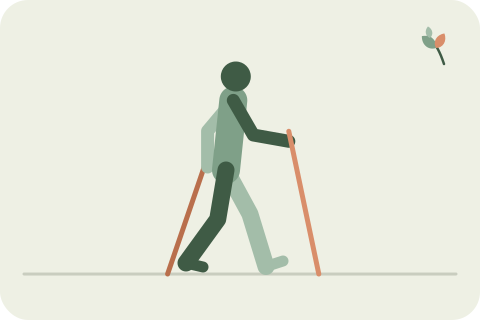
Walking, with poles if they help
Walking with poles or braces is among the activities the Charcot-Marie-Tooth Association (CMTA) suggests [65]. Poles add stability and bring the arms into the work.
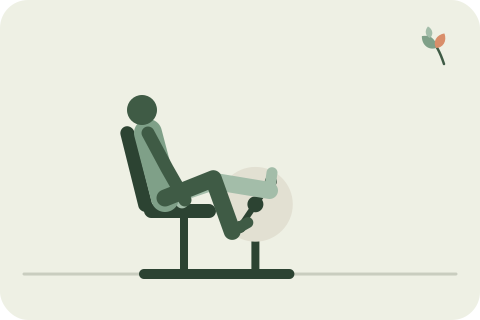
Cycling
Cycling three times a week for 12 weeks improved fitness in adults with CMT1A [244]. A recumbent or stationary bike takes balance out of the equation.
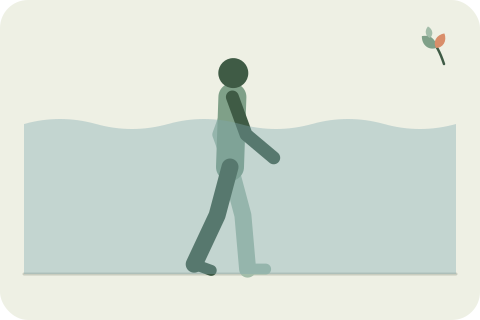
Swimming and water exercise
CMTA suggests swimming and water exercise [65]. Water supports your weight, so a fall is much less of a worry. Ask about step-free pool access and changing areas.
Strength training, yoga and Pilates are also suggested for CMT [65], and tai chi, dance and adaptive sports are other options people enjoy. If a group class is too fast, ask the instructor for a one-on-one session first, or look for classes for people with neurological conditions.
Keep it gentle enough to repeat
- Moderate, not maximal. High-intensity training has been linked to reduced performance and injury in neuromuscular disease, and lower intensity with more repetitions is recommended [56].
- Go by how it feels, but check it. People with neuromuscular disease often perceive effort differently from what their heart rate shows, which can lead to under- or over-training [256]. A physical therapist can help you calibrate your effort.
- Avoid overworking weak muscles, as a precaution. Whether overusing weak muscles speeds their decline is unresolved [64], and the UK's National Health Service (NHS) warns that overexerting yourself risks making symptoms worse [258].
Three plans for different kinds of weeks
These are my suggestions for structure, not evidence-based prescriptions. Pick the plan that fits the week you are actually having, and do not treat a low-energy week as failure.
Low-energy week
About 10 minutes, 3 days- One targeted exercise from your area, such as sit to stand or ankle lifts
- One stretch, such as the calf stretch
- A few minutes of belly breathing
- Everything else is rest without guilt
Standard week
About 20 to 30 minutes, 3 to 4 days- Your main activity on 2 or 3 days
- Two or three targeted exercises, twice a week
- Calf stretches most days
- Supported balance practice twice a week
Stronger week
About 30 to 45 minutes, 4 to 5 days- Your main activity on 3 or 4 days
- Strength work for the major muscle groups twice a week, with a rest day between
- Balance and stretching built into warm-ups
- Something just for fun
Make it easy to start
- Attach exercises to things you already do. Do sit to stands when you get up from a chair, calf stretches while the kettle boils, and finger spreads while watching TV.
- Track what matters to you. Note how far you can walk, how many sit to stands you can do in 30 seconds, or whether you can carry your groceries. Function is more motivating than repetitions.
- Get support. The researchers in the cycling trial concluded that self-motivation alone may not be enough for people with neuromuscular disease to keep exercising [244]. A friend, a class, a coach or online check-ins can help, and remote coaching is being explored for CMT [56].
- Plan for setbacks. After illness, a fall or a bad patch, restart with the low-energy plan rather than picking up where you left off.
I stop and scale back if I have weakness lasting more than 48 hours, new twitching or cramping, or pain in a joint rather than a muscle. Agree on your own stop signs with your physical therapist.
Exercise library with pictures
These are common exercises used in neuromuscular rehabilitation. The pictures show the movement; the arrows show the direction. Start with a few slow repetitions, breathe steadily rather than holding your breath, and stop if anything hurts. Check new exercises with a physical therapist, especially if you have scoliosis, hip problems or contractures (joints that have tightened and cannot move fully).
Feet and ankles
For ankles that still lift, and for keeping calves from tightening.
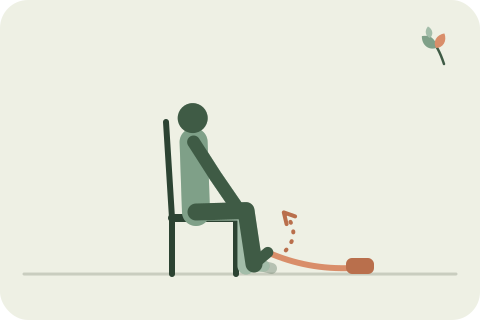
Seated ankle lift
- Sit with your heel on the floor.
- Lift the front of your foot toward your shin, hold for a moment and lower slowly.
- Repeat 8 to 15 times on each side.
- Easier
- No band; lift only as far as is comfortable.
- Harder
- Loop a light band around the forefoot, anchored in front of you, as in the picture.
Best if you can already lift your foot against gravity.
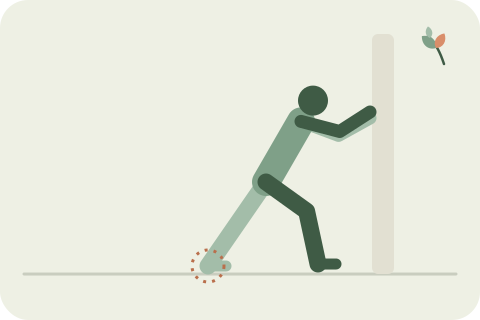
Wall calf stretch
- Stand facing a wall with your hands on it.
- Step one foot back, keeping that leg straight and the heel on the floor.
- Lean forward until you feel a stretch in the calf. Hold for 30 seconds, twice on each side.
- Easier
- Use a shorter step, or do the strap stretch while sitting.
- Also try
- Bend the back knee slightly to stretch the lower calf.
Daily heel cord (Achilles tendon) stretching is part of standard care [6].
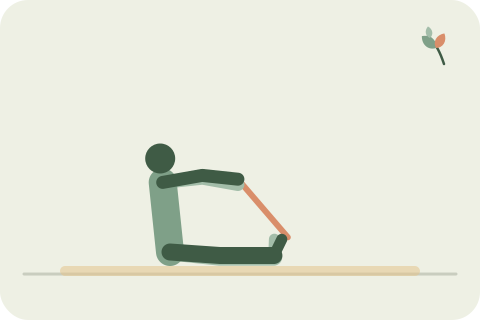
Seated strap stretch
- Sit with your legs straight out in front of you.
- Loop a strap or towel around the ball of one foot.
- Gently pull the toes toward you. Hold for 30 seconds, twice on each side.
- Easier
- Sit on a bed or against a wall for back support.
Good when you feel unsteady doing standing stretches.
Balance and getting up
For confidence on your feet and for everyday strength. Always keep support within reach.
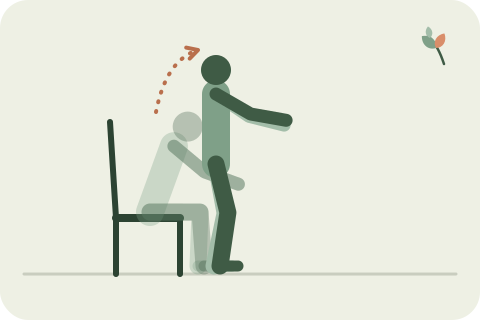
Sit to stand
- Sit near the front of a firm chair with your feet under your knees.
- Lean forward and stand up, then sit down slowly.
- Repeat 5 to 10 times.
- Easier
- Push up with your hands, or use a higher seat.
- Harder
- Fold your arms, or sit down more slowly.
One of the most useful exercises there is, because you do it all day.
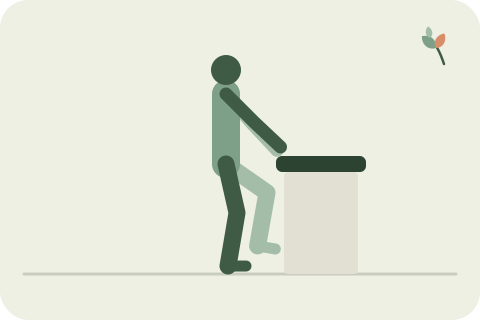
Supported balance
- Stand at a counter with one or both hands resting on it.
- Stand with feet together, then one foot in front of the other, then on one leg.
- Hold each for up to 30 seconds.
- Easier
- Keep your feet slightly apart and both hands on the counter.
- Harder
- Use a single fingertip, or turn your head slowly.
Wear your usual braces and shoes.
Hips, thighs and core
These muscles often compensate for weak ankles, which makes them worth keeping strong.
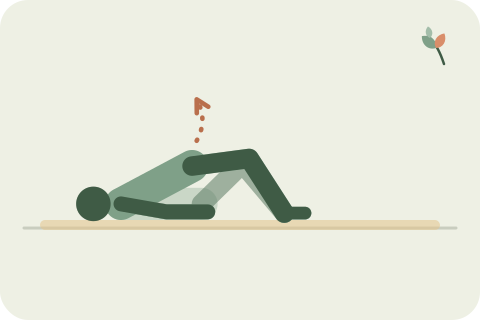
Glute bridge
- Lie on your back with your knees bent and feet flat.
- Squeeze your buttocks and lift your hips, then lower slowly.
- Repeat 8 to 15 times.
- Easier
- Lift only a little way.
- Harder
- Hold at the top for 3 seconds.
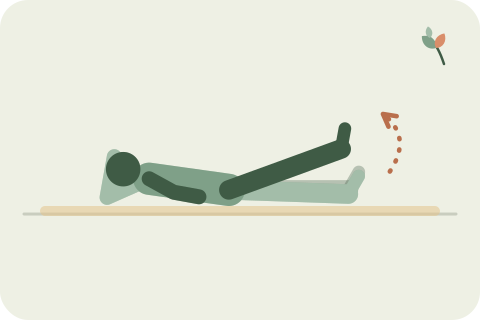
Side-lying leg raise
- Lie on your side with your head resting on your lower arm. Bend the bottom knee if that feels steadier.
- Lift the top leg a little way, keeping it in line with your body, then lower slowly.
- Repeat 8 to 15 times on each side.
- Easier
- Bend the top knee too.
- Harder
- Pause at the top.
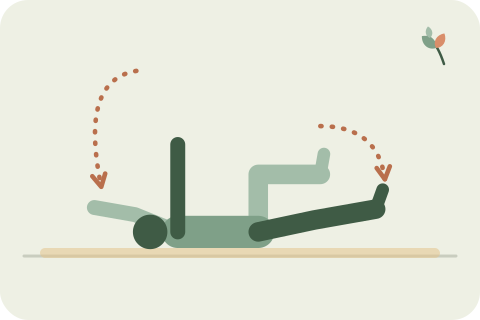
Dead bug
- Lie on your back with arms toward the ceiling and knees bent over your hips.
- Slowly lower one arm overhead and straighten the opposite leg, keeping your lower back on the floor.
- Return and switch sides. Repeat 5 to 10 times on each side.
- Easier
- Move only the arms, or only the legs, with feet on the floor.
Shoulders and arms
For carrying, reaching and supporting the shoulder blades. Shoulder weakness can be part of CMT2C [6], and arm and leg muscles close to the body are involved more often than in CMT1A [3].
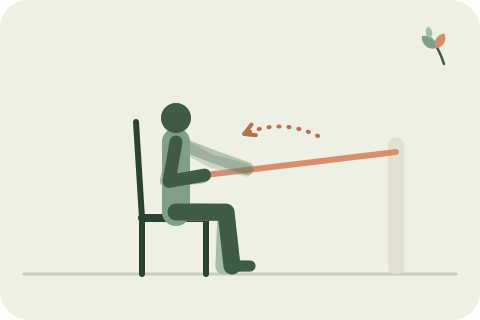
Seated band row
- Sit tall facing a band anchored at chest height.
- Pull the band toward your ribs, squeezing your shoulder blades together.
- Return slowly. Repeat 8 to 15 times.
- Easier
- Use a lighter band, or move closer to the anchor.
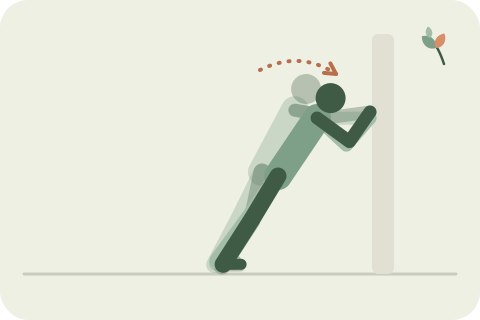
Wall push-up
- Stand an arm's length from a wall with your hands on it at shoulder height.
- Bend your elbows to bring your chest toward the wall, then push back.
- Repeat 8 to 15 times.
- Easier
- Stand closer to the wall.
- Harder
- Use a kitchen counter instead of the wall.
Needs reasonable wrist and hand strength.
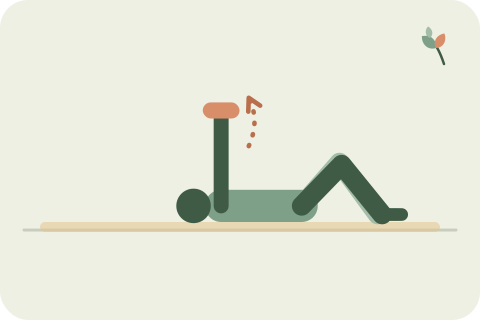
Lying serratus punch
- Lie on your back with your arms pointing at the ceiling.
- Reach your hands higher so your shoulder blades lift off the floor, then lower them.
- Repeat 8 to 15 times.
- Easier
- No weight.
- Harder
- Hold a light weight or a water bottle.
Works the muscle that holds the shoulder blade flat. Lying down supports a weak shoulder.
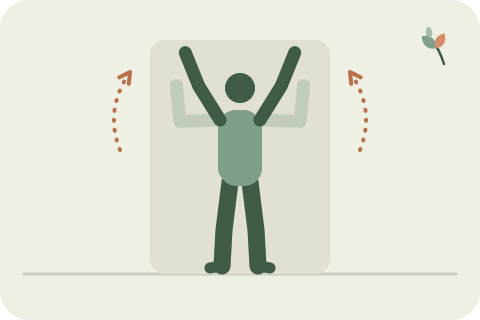
Wall slide
- Stand with your back against a wall and your arms bent in a W shape against it.
- Slide your arms up as far as is comfortable, then down.
- Repeat 5 to 10 times.
- Easier
- Do it lying on your back on the floor.
Hands
Pinch and thumb movement matter most for dexterity [249]. Keep these gentle and stop if your hands cramp.
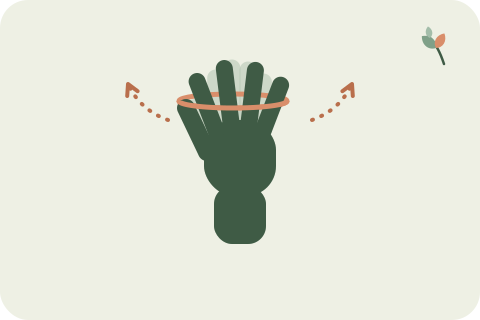
Finger spread
- Put a rubber band around your fingertips and thumb.
- Spread your fingers apart against the band, then relax.
- Repeat 10 times on each hand.
- Easier
- No band.
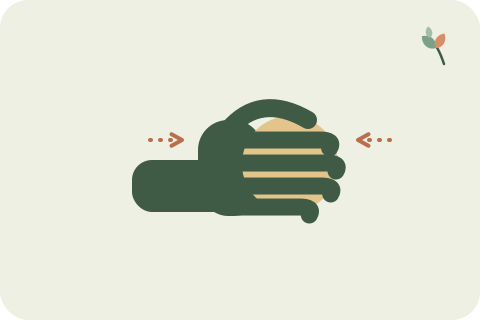
Putty squeeze and pinch
- Squeeze a ball of soft therapy putty in your fist, then relax.
- Then pinch pieces off between your thumb and each fingertip.
- Do a few minutes at a time.
- Easier
- Choose the softest putty.
Breathing
These exercises are relevant in CMT2C because the diaphragm can be affected [6]. Discuss breathing exercises with your team before you start.
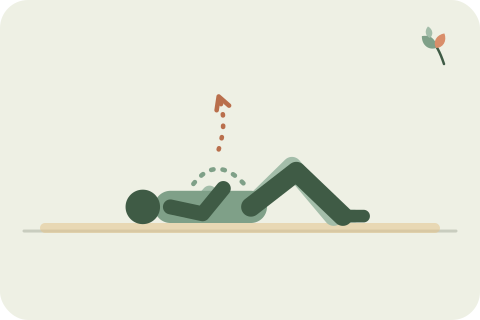
Belly breathing
- Lie or sit comfortably with a hand on your belly.
- Breathe in slowly through your nose so your belly rises under your hand.
- Breathe out slowly. Repeat for a few minutes.
- Note
- If lying flat makes you breathless, sit up instead and tell your doctor.
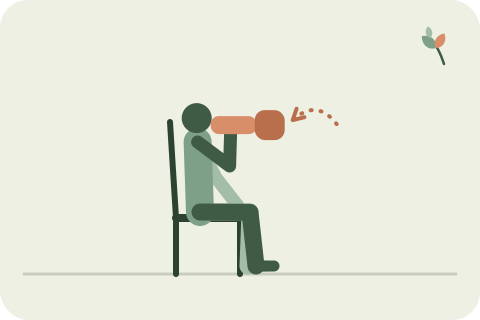
Breathing muscle trainer
- Only use one if your lung specialist or physical therapist recommends it.
- They will set the resistance and the number of breaths.
Training improved measures of breathing strength in neuromuscular disease, but not breathlessness or quality of life [251].
When the answer is a tool
Using a brace, splint or aid is not giving up. It often frees up energy for the things you care about.
- Ankle-foot orthoses. AFOs stiffen the ankle and lift the foot as it swings through, and they also reduce compensating movements at the hip and knee [233]. In a small crossover trial, median walking speed was 0.96 m/s in polypropylene AFOs compared with 0.79 m/s without an orthosis [234]. When provided according to a clinical guideline, AFOs improved walking speed and energy cost [235].
- Be realistic about braces. Across studies, the benefits for walking were small to moderate and not statistically significant when pooled [236]. In a survey of 266 people with CMT, 31% of AFO users had stopped using them, and complications were reported with 69% of AFOs, more often than with shoe inserts (47%) or orthopedic shoes (59%) [237]. Fit matters, so go back if a brace rubs, hurts or stops working for you.
- Hand splints and tools. A thumb opposition splint improved dexterity in a small study [250]. Jar openers, button hooks, thicker pens and lever faucets cost little and save effort.
- Mobility aids. Forearm crutches, canes, walkers and wheelchairs are part of standard care [6]. In the TRPV4 registry, 32% of participants used a wheelchair at least some of the time [3]. Using one for long distances can leave energy for exercise you enjoy.
- Surgery. For progressive foot deformity, today's approach favors joint-sparing surgery, combining soft-tissue procedures, bone realignment and tendon transfers [257].
Movement and mental health
Living with a progressive condition is hard, and your mental health deserves as much attention as your muscles. People with CMT are more prone to symptoms of depression than the general population [146].
- In the general population, walking or jogging, yoga and strength training all reduced depression in a large analysis of randomized trials, although confidence in the evidence was low to very low [255].
- Adults with CMT1A who played sports scored better on physical function and mental health than those who did not. That study shows an association, not cause and effect [254].
- The CMT1A cycling trial found no change in mood [244], so a single program is not a guaranteed lift. Enjoyment, company and a sense of progress probably matter as much as the exercise itself.
Grief over things you can no longer do is normal. If low mood or anxiety sticks around, tell your doctor. You can also find other people who understand on the community page.
Getting what you need from physical therapy
A yearly physical therapy assessment is part of recommended care for TRPV4 disease [6]. A therapist who knows neuromuscular disease is worth seeking out [65], and CMT Centers of Excellence offer multidisciplinary care [85]. Good research on exercise in CMT is still limited [258], so a good therapist will tailor your program rather than prescribe one from a template.
It is fine to negotiate. Try saying:
- “I can realistically do 15 minutes, three or four days a week. Which two or three exercises will make the biggest difference?”
- “Which of my muscles are strong enough to train, and which need a brace or another tool instead?”
- “Can we build these into things I already do, like walking or swimming?”
- “How hard should this feel, and what signs mean I should back off?”
- “What should I measure so we can tell whether it is working?”
- “Can you check my braces and footwear while I am here?”
Cautions specific to CMT2C
- Breathing and voice. Vocal fold weakness and diaphragm weakness are features of CMT2C [6]. Get your breathing checked before starting a new aerobic program [3], and scale back during colds, because upper respiratory infections can worsen airway obstruction [6].
- Standing up. In the TRPV4 registry, 41% of participants reported dizziness on standing [3]. Stand up slowly after floor or lying exercises, and keep support close.
- Spine and hips. In the TRPV4 registry, 64% of questionnaire respondents reported scoliosis and 18% had hip dysplasia [3]. Ask your team which movements suit your spine and hips.
- Uneven weakness. Weakness can be asymmetric and does not always start in the feet [6], so a generic CMT program may not fit. Train each side according to what it needs.
- Evidence gap. Most exercise studies involved CMT1A [240]. None were done in CMT2C.